(404) 971-2880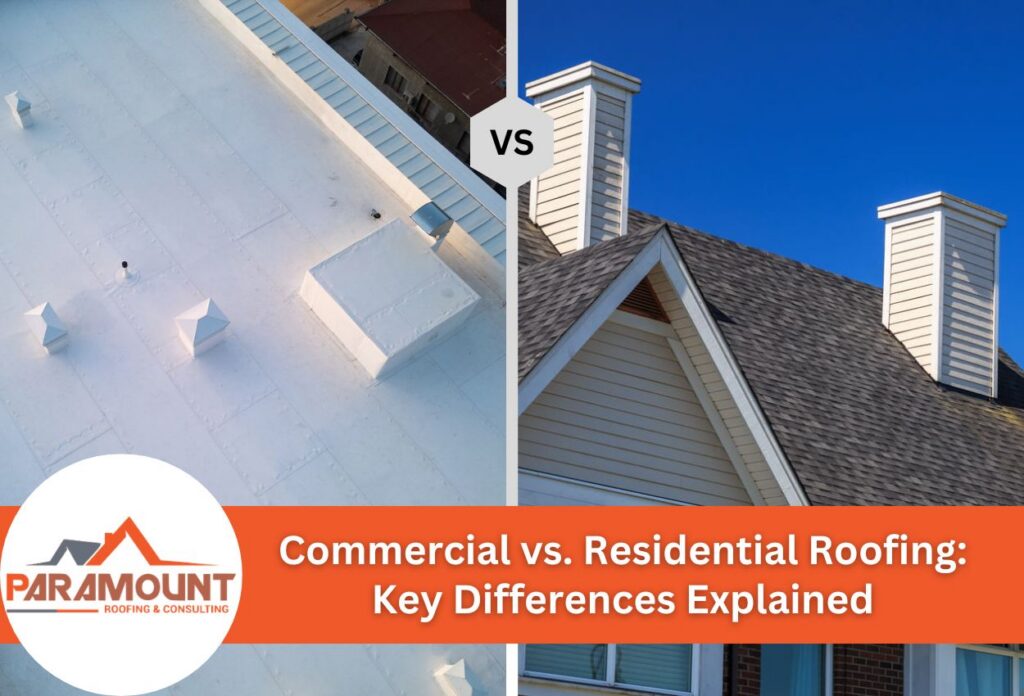

Commercial and residential roofing differ across five core areas: materials, slope and design, cost, lifespan, and maintenance complexity. Atlanta’s 50 inches of annual rainfall, frequent severe storms, and high summer humidity make those differences even more important for local property owners. The wrong system for your building type can lead to early failures, water damage, and repair costs that stack up fast.
The first is steep-slope residential homes, the ranch houses, two-story traditionals, and subdivision builds common across Atlanta’s suburban neighborhoods. The second is low-slope or flat commercial buildings, offices, retail centers, warehouses, and multifamily properties spread throughout the metro area.
*Please note, price ranges listed in this article may not reflect the final cost of your project. Prices are subject to change based on various factors such as local labor rates, material quality, and more. All costs established in this article are rough estimates based on average industry rates.
What Type of Roofing Do Commercial Buildings Use Compared to Residential Shingles?
Commercial roofing buildings and residential homes use entirely different roofing systems. Membrane systems dominate flat and low-slope commercial roofs, while asphalt shingles remain the most common choice on Atlanta’s steep-slope homes.
| Material Name | Roof Type | Common Application in Atlanta | Expected Lifespan (years) | Relative Cost per Sq Ft (installed) |
|---|---|---|---|---|
| TPO | Commercial | Warehouses, retail centers | 15 to 25 years | $5 to $9 |
| EPDM | Commercial | Office buildings, flat rooftops | 15 to 25 years | $4 to $8 |
| PVC | Commercial | Restaurants, buildings with rooftop HVAC | 20 to 30 years | $6 to $10 |
| Modified Bitumen | Commercial | Low-slope multifamily, older commercial | 15 to 20 years | $4 to $7 |
| Asphalt Shingles | Residential | Single-family homes, subdivisions | 20 to 30 years | $3 to $6 |
| Metal Roofing | Both | Homes, commercial buildings, mixed-use | 40 to 70 years | $8 to $16 |
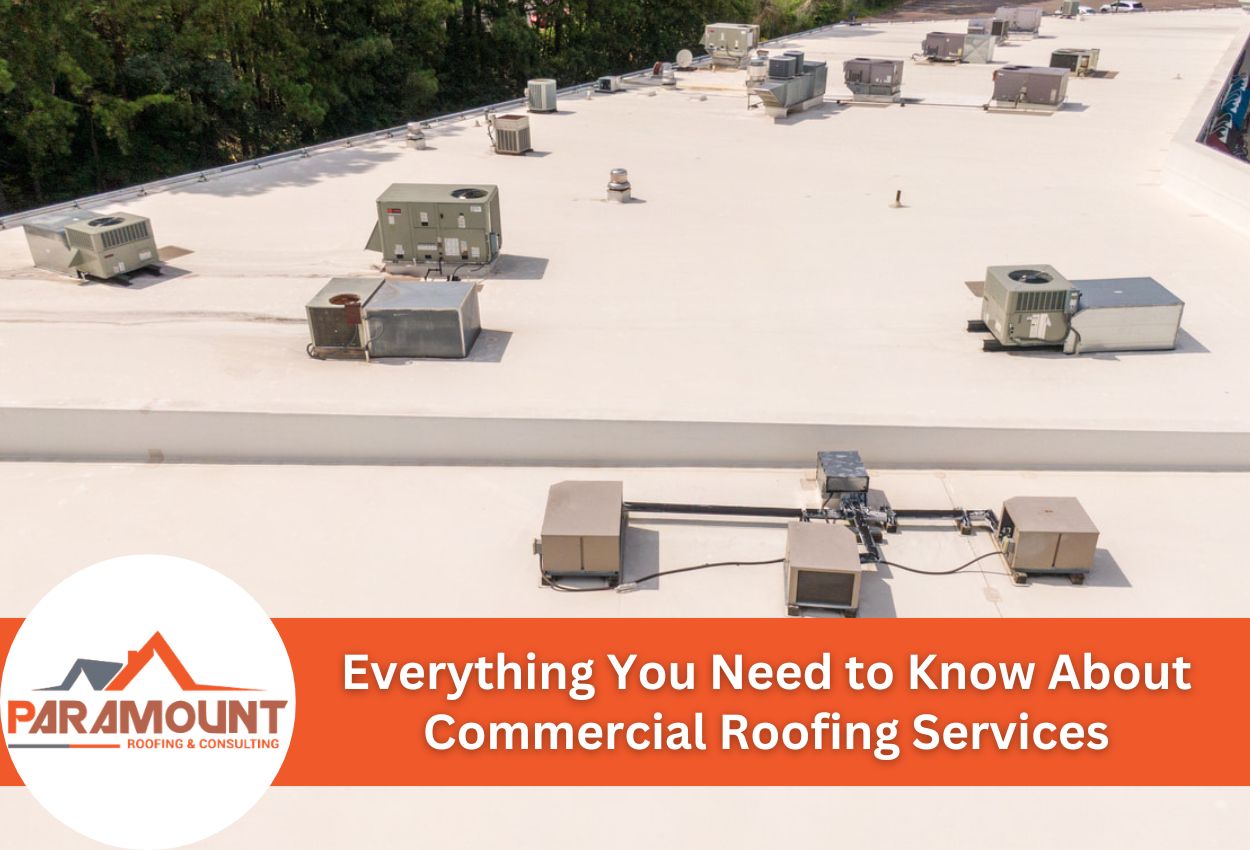
Flat and low-slope commercial roofs cannot use shingles because shingles depend on a steep pitch to shed water fast. Without enough slope, water sits on the surface, a condition called ponding, and works its way under overlapping shingles within months. Rooftop HVAC units, pipes, and drains also create gaps that require fully adhered or mechanically fastened membranes to seal properly around every opening.
Atlanta’s summer highs in the upper 80s to low 90s and strong UV exposure make reflective membranes like TPO and PVC especially practical for commercial buildings. They reject heat rather than absorb it, which can lower cooling costs during the region’s long, hot summer season. Metal roofing stands out as the only material that works well across both building types while delivering the longest lifespan in the comparison.
Why Is Commercial Roofing More Expensive Than Residential Roofing?
Commercial roofing costs more because it covers far more square footage, requires multi-layer insulation systems, and involves rooftop equipment that demands custom flashing work costs that most residential re-roofing jobs never include.
| Cost Factor | Residential Roofing | Commercial Roofing |
|---|---|---|
| Average Project Size | 1,500 to 3,000 sq ft | 5,000 to 50,000+ sq ft |
| Installed Cost per Sq Ft | $3 to $6 | $5 to $12+ |
| Typical Total Project Cost | $6,000 to $18,000 | $25,000 to $200,000+ |
| Labor Complexity | Low to medium | High |
| Insulation Requirements | Minimal | R-20 to R-30 commonly required |
| Permit and Inspection Costs | Lower, often under $500 | Higher, $500 to $2,500+ |
Three factors drive commercial costs well above residential levels. First, larger square footage means more material ordered, more crew days on-site, and more equipment to move across the roof. Second, rooftop HVAC units, vents, and pipes require custom flashing and gap work around every opening. Each one adds labor time and material cost that a standard residential replacement rarely needs. Third, commercial low-slope systems commonly require a cover board plus R-20 to R-30 insulation layers under the membrane, adding materials that residential shingle jobs skip entirely.
Georgia contractor licensing requirements and Atlanta’s commercial inspection protocols also add administrative costs. Commercial permits in the Atlanta area commonly run $500 to $2,500+, compared to under $500 for most residential re-roofing jobs, a gap that widens further when third-party inspections are required on larger projects.
How Long Does a Commercial Roof Last vs. a Residential Roof and What Affects Lifespan in Atlanta?
Metal roofing lasts the longest of any system, 40 to 70 years on both commercial and residential buildings, while most membrane commercial roofs last 15 to 30 years, and asphalt shingle roofs in Atlanta typically last 20 to 25 years, which is shorter than the national average of 25 to 30 years due to the region’s intense UV exposure and summer heat.
| Roofing System | Average Lifespan (Atlanta Conditions) | Primary Degradation Factor in Atlanta |
|---|---|---|
| TPO | 15 to 25 years | Ponding water, UV exposure |
| EPDM | 15 to 25 years | Humidity, membrane shrinkage |
| PVC | 20 to 30 years | Wind uplift at seams, rooftop heat |
| Asphalt Shingles | 20 to 25 years | UV and heat stress, wind damage |
| Metal Roofing | 40 to 70 years | Wind uplift, fastener corrosion from humidity |
Atlanta’s heavy tree canopy adds another layer of wear on both roof types. Debris buildup, shaded moisture retention, and clogged drainage block water from clearing the surface of the roof, a problem that hits flat commercial roofs hardest. Ponding water left standing for 48 hours or more accelerates membrane breakdown and can void manufacturer warranties faster than almost any other factor.
Commercial membrane warranties often require documented annual inspections to remain valid, and most roofing professionals recommend semi-annual inspections once in spring and once in fall for both commercial and residential roofs in the Atlanta area. Skipping those checkups is one of the most common reasons roofs fail years before their rated lifespan ends. Paramount Roofing & Consulting can assess where your roof stands and what maintenance will keep it performing as long as possible.
What Should Atlanta Property Owners Know About Maintaining a Commercial vs. Residential Roof?
Commercial roofs demand drainage and membrane checks, while residential roofs need shingle and flashing inspections, and catching small problems early is the difference between a $300 repair and a $20,000 replacement.
Commercial Roof Maintenance Tasks
- Clear rooftop drains and scuppers: Blocked drainage causes ponding water, which can void membrane warranties if water stands for 48 hours or more.
- Inspect membrane seams and flashings: Small seam separations or flashing failures cost $300 to $800 to fix when caught early, but ignored, they can push interior water damage and insulation replacement to $5,000 to $20,000 or more.
- Check HVAC curbs and gaps: Every rooftop unit creates a seal point that should be examined at least twice a year for gaps or lifted flashing.
- Document conditions for warranty compliance: Most commercial membrane warranties require written inspection records to stay valid. A commercial roof maintenance program can help ensure documentation stays current.
- Monitor for ponding water after storms: Water still standing 48 hours after rain signals a drainage problem that needs fast attention.
Residential Roof Maintenance Tasks
- Inspect shingles after hail or wind storms: Check for damage within 48 hours of any storm with hail exceeding 1-inch stones.
- Clear gutters of leaf debris: Atlanta’s heavily wooded neighborhoods drop enough debris to block gutters several times a year, backing water up under shingles.
- Check attic ventilation: Poor ventilation traps summer heat above 150 degrees Fahrenheit and shortens shingle life by years.
- Reseal flashing around chimneys and skylights: Minor flashing repairs run $150 to $400 deferred. They lead to roof decking rot and interior damage, averaging $2,000 to $8,000.
- Replace granule-depleted shingles: Once granules wash away, the asphalt layer below is exposed to UV damage and degrades fast.
Scheduling inspections in September and October after Atlanta’s summer storm season and before winter lines up with the region’s best dry-weather repair window and keeps both commercial and residential roofs ahead of bigger problems. Paramount Roofing & Consulting can identify which repairs fall into the “fix now” category before costs climb.
How Do You Know Which Type of Roofing Contractor You Need for Your Atlanta Building?
Not all roofing contractors are licensed or equipped for both building types in Georgia. Commercial projects above $2,500 trigger state licensing requirements, and the license class a contractor holds must match the project type before any contract is signed.
- Roof slope under 2:12 pitch: A slope that low almost always requires a commercial membrane contractor with flat-roof installation experience, not a residential shingle crew.
- Building used commercially or with more than 4 units: Confirm the contractor holds a commercial license through the Georgia State Licensing Board before moving forward.
- Project cost over $2,500: Georgia licensing thresholds apply at this level, so verifying the contractor’s license class is not optional. It protects the property owner legally.
- Rooftop HVAC units or pipe gaps involved: This work requires commercial membrane and custom flashing experience that most residential contractors do not carry.
- Replacing asphalt shingles on a single-family home: A residential-licensed contractor is appropriate, and most standard re-roofing jobs in Atlanta fall into this category. A residential roof inspection can confirm the scale before work begins.
- Manufacturer warranty required: Confirm the contractor is a certified installer for the specific membrane or shingle brand. Uncertified installs typically void factory warranty coverage.
Atlanta’s competitive roofing market means some contractors claim both residential and commercial capabilities. Always request project photos, references, and insurance certificates specific to the project type. Commercial general liability limits are typically higher, often $1 million to $2 million per occurrence, compared to standard residential coverage. Matching the contractor’s license and insurance to the job protects the investment before work begins.
Which Roofing Investment Delivers Better Long-Term Value: Commercial or Residential?
Metal roofing delivers the lowest amortized annual cost over time, but the right system depends on building size, use, and energy goals. A TPO commercial roof installed on a 10,000 sq ft building at $7 per sq ft costs $70,000 upfront, spread over a 20-year lifespan, which works out to roughly $3,500 per year. A residential asphalt shingle roof on a 2,000 sq ft home at $5 per sq ft costs $10,000 upfront, spread over 22 years, which is approximately $455 per year. Commercial roofing costs more in total, but the per-year gap narrows at a larger scale.
| Roofing System | Example Upfront Cost | Estimated Lifespan | Annual Amortized Cost | Typical Warranty Length |
|---|---|---|---|---|
| TPO (commercial, 10,000 sq ft) | $70,000 | 15 to 25 years | About $3,500/year | 10 to 20 years |
| Asphalt Shingles (residential, 2,000 sq ft) | $10,000 | 20 to 25 years | About $455/year | 25 to 30 years |
| Metal Roofing (commercial or residential) | $20,000 to $40,000+ | 40 to 70 years | About $400 to $700/year | 30 to 50 years |
Energy efficiency adds measurable ROI for commercial buildings. Reflective TPO and PVC membranes can reduce rooftop cooling usage by 10% to 20%, a real factor during Atlanta’s long, hot summers. That energy savings does not apply to standard residential asphalt shingles, making reflective membranes a stronger long-term value play for commercial property owners specifically. Review both upfront costs and amortized figures before choosing a system.
Ready to Plan Your Roofing Project in Atlanta?
Scheduling a roof assessment before Atlanta’s spring storm season or securing your spot in the fall inspection window can be the difference between a $300 repair and a $20,000 emergency replacement after a severe storm. Contractor availability fills fast in both windows, and early assessment puts you ahead of the backlog.
Whether you own a commercial building or a single-family home in the Atlanta metro area, Paramount Roofing & Consulting offers commercial roofing services and residential roofing services, including on-site inspections and project estimates matched to your specific type of roof and building use.
Schedule your free roof inspection.
Not ready to schedule? Learn more about residential roofing services.