(404) 971-2880
TPO Replacement vs. EPDM Replacement: Which Membrane Is Right for Your Atlanta Flat Roof?
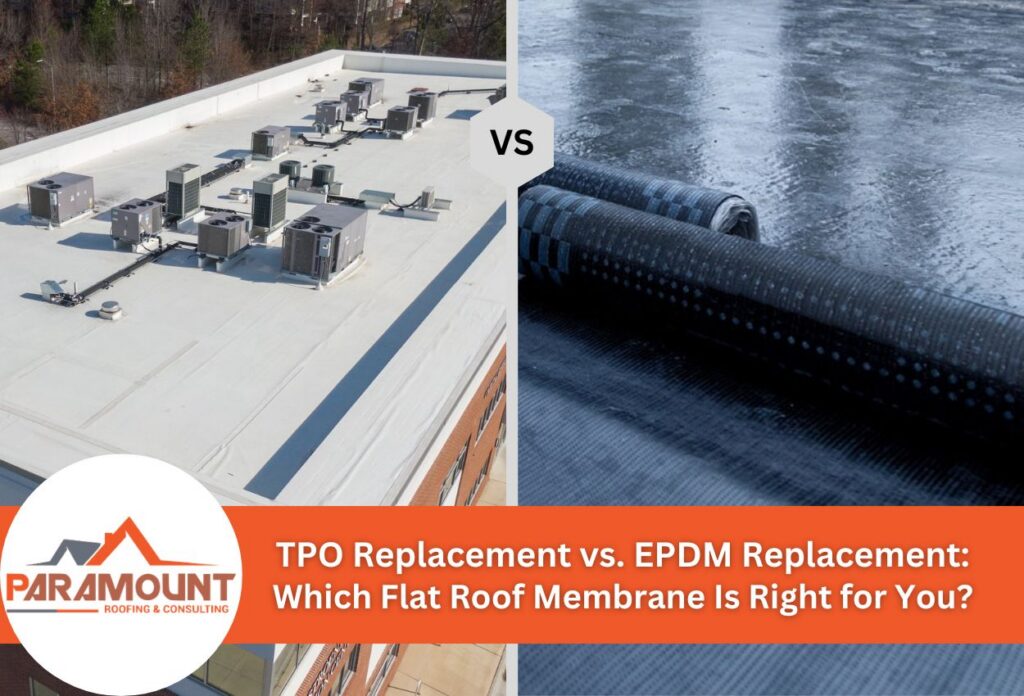

For most Atlanta flat roofs, TPO is the more commonly recommended membrane because its white, reflective surface reduces cooling during summers that regularly hit the upper 80s to low 90s. That said, EPDM remains a solid choice for specific building conditions where flexibility and easier field fabrication matter more than heat reflection.
TPO is a heat-welded thermoplastic membrane, typically installed in white or light gray, with seams fused using hot air. EPDM is a rubber membrane almost always installed in black with seams joined using adhesive or tape rather than heat welding.
That core difference shapes how each membrane performs in Atlanta’s heat, how long each lasts, what each costs, and which buildings each fits best.
*Please note, price ranges listed in this article may not reflect the final cost of your project. Prices are subject to change based on various factors such as local labor rates, material quality, and more. All costs established in this article are rough estimates based on average industry rates.
How Do TPO and EPDM Compare on Cost, Lifespan, and Core Performance?
TPO runs $5.50 to $8.50 per square foot installed, while EPDM comes in slightly lower at $4.50 to $7.50 per square foot, but the cost per square foot is only part of the story.
| Category | TPO | EPDM |
|---|---|---|
| Installed Cost (per sq. ft.) | $5.50 to $8.50 | $4.50 to $7.50 |
| Expected Lifespan | 20 to 30 years | 25 to 35 years (with proper maintenance) |
| Manufacturer Warranty Range | 10 to 20 years | 10 to 20 years |
| Seam Method | Hot-air welding | Adhesive or tape |
| Surface Reflectivity | High white or light gray surface | Low black standard surface |
EPDM carries a slight lifespan edge in controlled conditions, with a range of 25 to 35 years versus 20 to 30 years for TPO. However, in Atlanta’s hot summers, TPO’s reflective white surface reduces solar heat gain and lowers cooling energy demand, an advantage that can offset TPO’s higher per-square-foot cost over time. When comparing TPO roof replacement cost vs. EPDM roof replacement cost, material costs alone don’t capture the full picture. Installation labor, roof size, gap count, and building-specific conditions all affect the total project cost.
Which Membrane Holds Up Better to Atlanta’s Heat, Humidity, and Storm Conditions?
TPO generally holds up better under Atlanta’s specific climate stressors because its reflective white surface reduces heat aging, a real advantage when summer temperatures regularly hit the upper 80s to low 90s and rooftop surfaces bake under direct sun for months at a time. EPDM’s black surface can reach temperatures up to 50 to 60 degrees higher than TPO under the same conditions, which accelerates material aging and increases thermal cycling stress on seams and flashings over time.
Atlanta receives about 50 inches of rain each year, with frequent afternoon thunderstorms delivering hard, wind-driven rain across the warm season. Seam performance under those conditions matters. TPO hot-air-welded seams, when installed correctly, produce a bond rated at 350 to 500 psi peel strength, stronger than the membrane itself. EPDM adhesive seams are more vulnerable to lap failure when surface preparation falls short or when installation happens during high humidity, which is a real scheduling challenge in Atlanta’s warm season.
Puncture resistance is another factor worth weighing on Atlanta commercial and multifamily buildings, where rooftop HVAC equipment and service traffic are common. TPO membranes are generally rated at 20% to 30% higher puncture resistance than standard EPDM, making TPO a better fit for roofs that see regular foot traffic around mechanical units. For Atlanta buildings with heavy rooftop equipment, frequent storms, and long cooling seasons, TPO’s combination of reflectivity, weld strength, and puncture resistance gives it a clear durability edge over standard EPDM. EPDM still performs well in lower-traffic applications where flexibility and adhesive detailing are managed carefully.
Is TPO or EPDM Easier to Install, and How Does That Affect Your Replacement Timeline?
EPDM is generally considered more forgiving to install because it can be cut and seam with basic hand tools, while TPO requires trained operators using hot-air welding equipment, making contractor skill the single biggest variable in TPO installation quality. Both membranes require a similar crew size and take roughly the same number of days to complete, but the skill gap between an experienced TPO crew and an undertrained one is far wider than it is with EPDM, making EPDM roofing systems a practical option for projects where installation simplicity and reliable workmanship are important considerations.
| Installation Factor | TPO | EPDM |
|---|---|---|
| Weather Sensitivity During Install | Moderate | Higher adhesive cure is sensitive to high humidity |
| Typical Crew Size (10,000 sq. ft.) | 3 to 5 workers | 3 to 5 workers |
| Estimated Install Time (10,000 sq. ft.) | 2 to 4 days | 2 to 4 days |
| Best Scheduling Window in Atlanta | Spring or fall, avoid June through August afternoon storms | Spring or fall, avoid June through August afternoon storms |
Atlanta’s permitting process adds 3 to 6 weeks to project timelines before any work can begin, so build that window into your planning from the start.
TPO vs. EPDM Flat Roof Replacement Pros & Cons: Which Scenarios Favor Each Material?
TPO is the better fit for most Atlanta buildings, but EPDM earns its place in specific conditions, particularly when the budget is tight or building geometry makes field fabrication a priority. Use these two lists to match the right membrane to your actual building.
Choose TPO if…
- Your building sits in a heat-island area of the Atlanta metro: TPO’s white or light gray surface reflects solar heat, reducing cooling needs during summers that regularly hit the upper 80s to low 90s. Learn more about commercial TPO roofing installation and how it performs in Atlanta’s climate.
- The roof sees regular foot traffic from HVAC service crews: TPO rates 20% to 30% higher in puncture resistance than standard EPDM, making it the better choice around rooftop mechanical units.
- You want to qualify for ENERGY STAR or cool-roof credits: TPO’s reflective surface meets the surface reflectivity thresholds required for most cool-roof incentive programs.
- The building is a newer commercial structure: Weld-quality TPO contractors are widely available in Atlanta, so finding a crew with certified hot-air welding experience is straightforward.
Choose EPDM if…
- The roof has complex geometry with many gaps: EPDM’s field-fabrication flexibility reduces labor time and cost when a crew must hand-cut and fit membrane around multiple curbs, pipes, or drains.
- Roof sections are shaded or face a northern exposure: Reflectivity provides less benefit when direct sun exposure is limited, so TPO’s main advantage shrinks on those sections.
- Budget is the deciding factor: EPDM’s installed cost runs $0.50 to $1.00 per square foot less than TPO, which adds up quickly on larger roofs. Explore commercial EPDM roofing services for Atlanta buildings where this membrane is the right fit.
- The existing roof is already EPDM: Replacing EPDM over EPDM simplifies compatibility, reduces the risk of adhesion issues, and can lower overall replacement costs.
Neither membrane wins in every situation: the right choice depends on your roof’s sun exposure, traffic level, geometry, and budget. A reputable contractor can assess all four factors before recommending one over the other.
What Is the Long-Term ROI of TPO vs. EPDM Replacement for Atlanta Property Owners?
On a 10,000 sq ft roof, TPO replacement averages $70,000 installed at $7.00 per square foot, while EPDM comes in at $60,000 at $6.00 per square foot, a $10,000 upfront difference that makes EPDM look like the obvious choice until you factor in energy costs.
In a hot climate like Atlanta’s, a white TPO membrane can reduce rooftop cooling energy consumption by 10% to 30% compared to a dark membrane. On a 10,000 sq ft commercial building, that translates to roughly $500 to $2,000 in annual energy savings depending on HVAC efficiency and occupancy patterns. At $1,000 per year in savings, the $10,000 TPO premium reaches payback in approximately 10 years, which lines up almost exactly with the midpoint of both systems’ 10 to 20-year warranty periods. That payback timeline makes TPO a stronger long-term value in Atlanta’s climate, where cooling is high for months at a time.
Maintenance Costs Over Time
Both systems carry comparable warranty terms of 10 to 20 years, but maintenance costs diverge in the second decade. EPDM adhesive seams typically require re-sealing between years 10 and 15, adding $0.50 to $1.50 per linear foot of seam to maintenance budgets. TPO’s hot-air welded seams generally require less re-treatment over the same period, which keeps long-term maintenance costs lower on most commercial roofs. A proactive commercial roof maintenance program can extend the service life of the membrane and catch seam issues before they become expensive failures.
For Atlanta property owners weighing the total cost of ownership rather than upfront costs alone, the energy savings plus lower seam maintenance give TPO a measurable financial edge over a full roof cycle.
Ready to Replace Your Atlanta Flat Roof? Here’s How to Get Started
With TPO’s 10-year energy payback and lower long-term seam maintenance costs, the right membrane choice can save Atlanta property owners thousands over a full roof cycle, but only if the installation is done correctly by a licensed, experienced crew. Paramount Roofing & Consulting serves the Atlanta metro area with comprehensive commercial roofing services, including licensed, insured crews trained in both TPO hot-air welding and EPDM adhesive seam installation on commercial and multifamily flat roofs.
Whether the building needs a full tear-off, a recover system, or reinforced flashing work at gaps and drains, the team can assess the roof and deliver a membrane-specific replacement quote for both TPO and EPDM options. Same-week site visits are available for Atlanta-area property owners and facilities managers ready to move forward.
Request your free roof assessment.
Not ready to schedule? Learn more about flat roof membrane replacement.